
One of the most common questions we hear is simple: “When will I see results?” Here’s what to expect after a hair transplant, month by month.
For many patients, the decision to move forward with a hair transplant isn’t driven by concerns about the procedure itself. It’s driven by questions about recovery.
- Will people notice?
- How long before I can return to work?
- When will the new hair start growing?
- What will I look like in the weeks and months after treatment?
At Wolf Hair Restoration in Cincinnati, we believe that setting realistic expectations is one of the most important parts of the consultation process. Hair transplantation delivers permanent results, but it requires patience. Understanding the timeline beforehand helps patients feel confident and prepared throughout the process.
Here’s what most patients can expect after a modern FUE, FUT, or ARTAS® hair transplant.
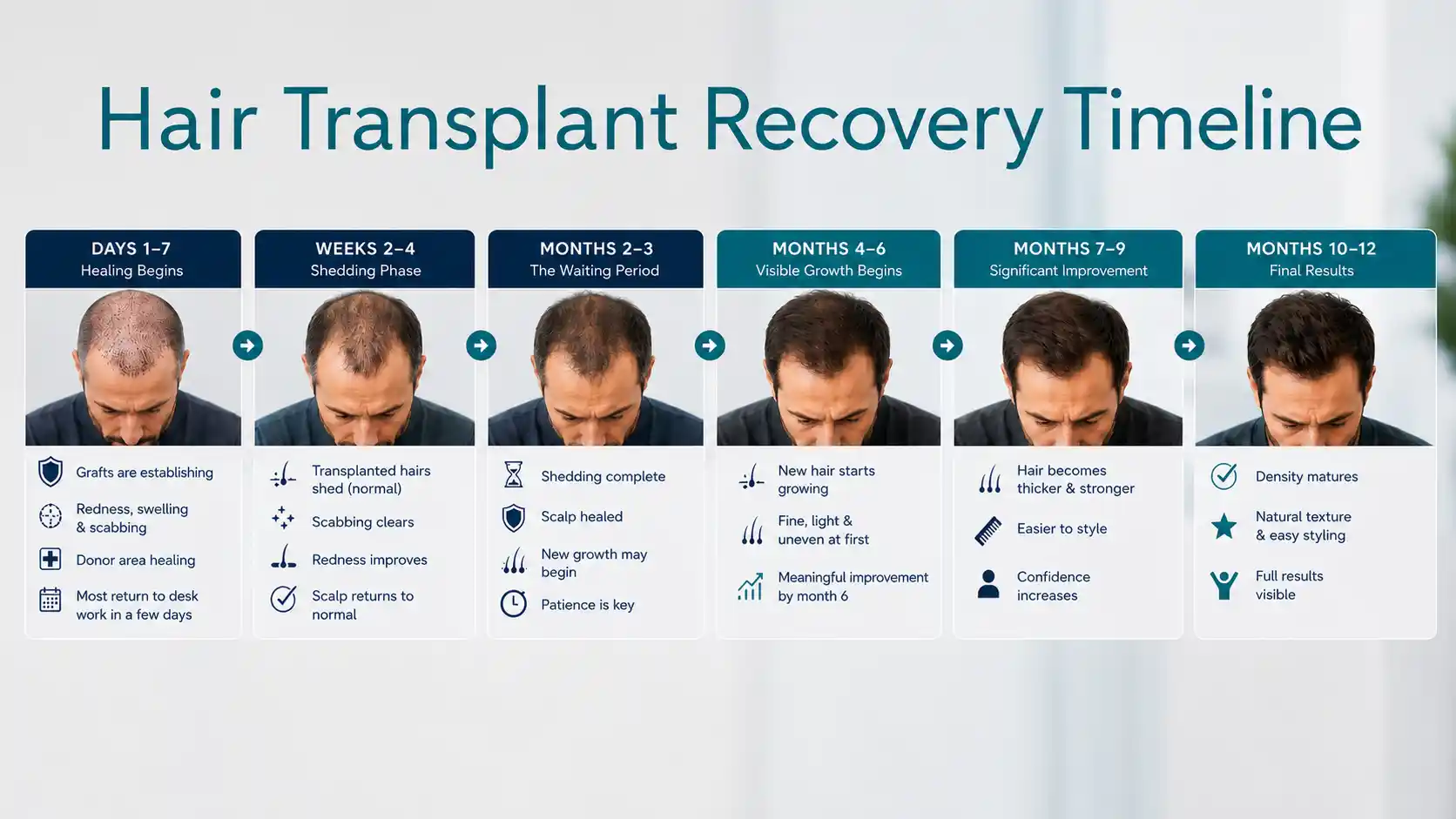
Days 1–7: Healing Begins
The first week is focused primarily on healing.
Immediately following the procedure, you’ll notice small graft sites throughout the recipient area. Mild redness, swelling, and scabbing are completely normal during this stage.
Most patients spend the first few days taking it easy and following their post-procedure instructions carefully.
During this period:
- The transplanted grafts are becoming established.
- Mild swelling may occur around the forehead.
- Small scabs form around each graft.
- The donor area begins healing.
Many patients return to desk work within several days, although everyone heals at a slightly different pace.
By the end of the first week, most visible signs of the procedure have improved significantly.
Weeks 2–4: The “Shedding Phase”
This is often the stage that surprises patients the most.
Many of the transplanted hairs begin to shed.
While it can feel alarming, this process is completely normal and expected.
The follicles themselves remain healthy and intact beneath the scalp. The visible hair shafts shed while the follicles enter a temporary resting phase before beginning new growth.
In fact, shedding is often a sign that recovery is progressing exactly as expected.
At this point:
- Most scabbing has cleared up.
- Redness continues to improve.
- Transplanted hairs may begin shedding.
- The scalp generally appears much closer to normal.
For many patients, this is the most psychologically challenging stage because the final results are still months away.
Month 2–3: The Waiting Period
By the second and third month, most patients look very similar to how they did before surgery.
This is completely normal.
The transplanted follicles are still alive beneath the surface, but visible growth has not yet begun in a meaningful way.
During this phase:
- Shedding is typically complete.
- The scalp appears healed.
- New growth may begin in small areas.
- Most patients are simply waiting for the next stage.
Patience is important. Hair restoration is a long-term process, not an overnight transformation.
Month 4–6: Visible Growth Begins
This is where things start getting exciting.
Between months four and six, most patients begin seeing noticeable growth throughout the treated area.
The new hairs often appear:
- Fine at first
- Lighter in texture
- Somewhat uneven
This is entirely normal.
The follicles are becoming active again and producing new hair. Over time, those hairs gradually become thicker, stronger, and more consistent.
By the six-month mark, many patients are already seeing meaningful cosmetic improvement.
Friends and family may begin commenting on the change, even if they can’t identify exactly what’s different.
Month 7–9: Significant Improvement
During this stage, density continues increasing.
Hair becomes:
- Thicker
- Stronger
- More mature
- Easier to style
For many patients, this is when they begin feeling that the procedure was truly worthwhile.
The hairline becomes more defined, areas of thinning become less noticeable, and confidence often improves substantially.
While excellent progress is typically visible by this point, the final result is still developing.
Month 10–12: Final Results Take Shape
Around the one-year mark, most patients have achieved the vast majority of their final outcome.
The transplanted hair continues behaving like natural hair because it is natural hair.
By this stage:
- Density has largely matured.
- Hair texture appears more natural.
- Styling becomes easier.
- The overall restoration is fully apparent.
For patients undergoing crown restoration, growth may continue improving slightly beyond the one-year mark.
Factors That Influence Recovery
Every patient heals differently.
Several factors can affect your timeline:
- Age
- Genetics
- Overall health
- Hair characteristics
- Procedure type
- Number of grafts
- Adherence to post-operative instructions
This is why individualized follow-up care is so important throughout the process.
The Most Important Thing to Remember
Hair restoration is a marathon, not a sprint.
- The first few weeks focus on healing.
- The first few months require patience.
- The final result develops gradually over the course of a year.
Patients who understand this timeline ahead of time tend to enjoy a much more comfortable recovery experience because they know exactly what to expect at every stage.
Considering a Hair Transplant in Cincinnati?
At Wolf Hair Restoration, Dr. Scott Welden and our team guide patients through every phase of the process, from consultation and procedure planning, to recovery and long-term follow-up.
If you’re considering a hair transplant and would like a personalized assessment of your options, we invite you to schedule a consultation. We’ll discuss your goals, answer your questions, and help you understand what your own recovery timeline may look like.
Wondering What Your Recovery Could Look Like?
Get personalized answers about downtime, healing, growth timelines, and what to expect based on your specific procedure and goals.