

Two proven surgical techniques. One permanent outcome. Here’s how to know which path fits your hair loss, lifestyle, and goals.
If you’re considering a hair transplant, you’ve likely come across two acronyms that seem to appear everywhere: FUE and FUT. Both are proven surgical techniques that deliver permanent, natural-looking results, but they differ in how donor hair is harvested, how you’ll recover, and who each approach suits best.
At Wolf Hair Restoration in Cincinnati, Dr. Scott Welden and our team have spent decades helping patients navigate exactly this decision. We perform both procedures (along with ARTAS® robotic transplants) and tailor every recommendation to the individual patient, not a one-size-fits-all formula. This guide will walk you through the key differences so you can walk into your consultation well-prepared.
What Does Each Procedure Actually Involve?
FUE
Follicular Unit Extraction
Minimally invasive · No linear scar
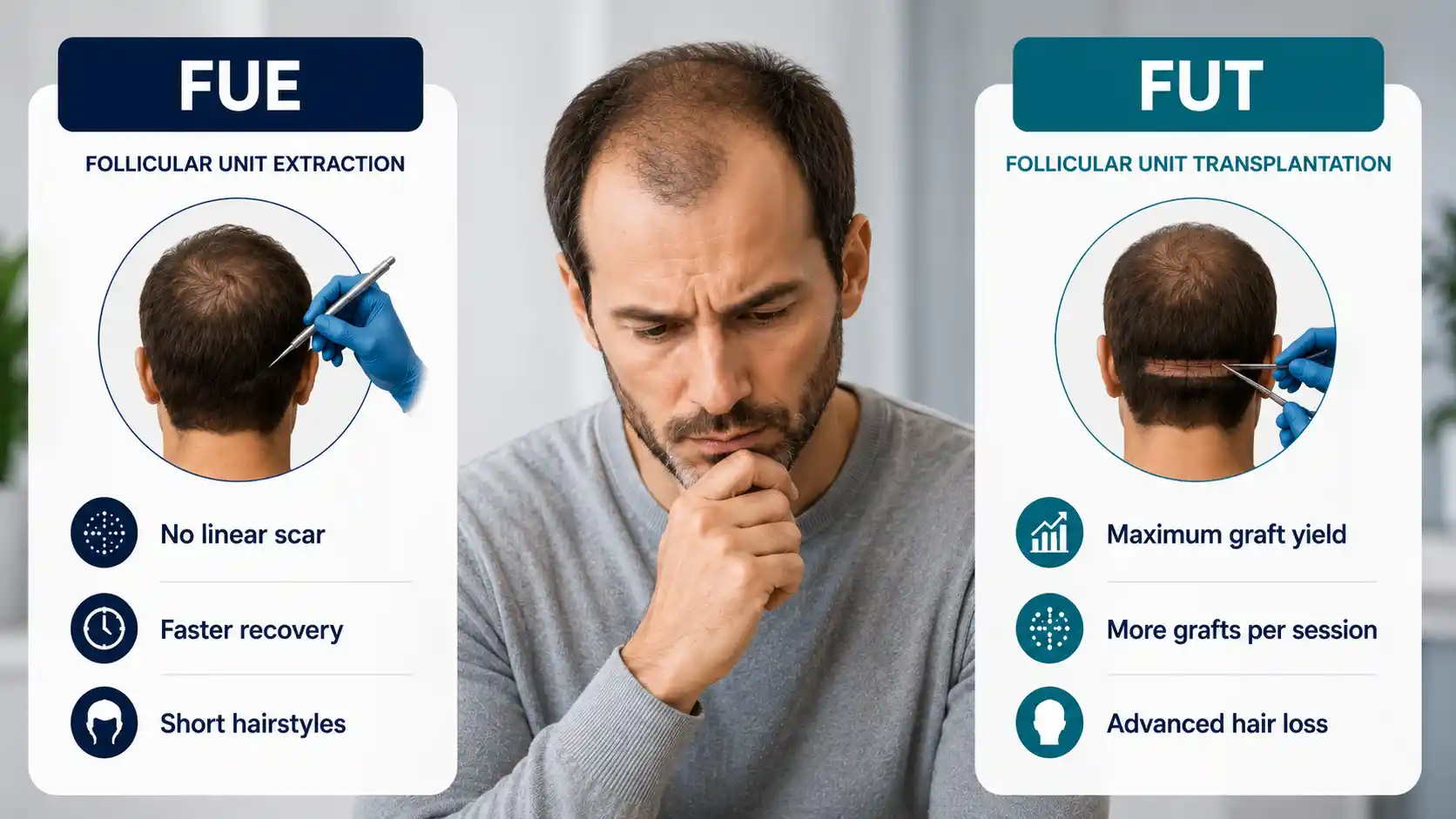
- Individual follicles extracted one by one
- Small circular punch wounds that heal quickly
- No linear scar, ideal for short hairstyles
- Return to work within a few days
- Also used for beard, eyebrow & scar restoration
FUT
Follicular Unit Transplantation
Strip method · Maximum graft yield
- Strip of hair-bearing skin removed from the back of scalp
- Grafts separated under a microscope for high precision
- Thin linear scar, easily hidden by surrounding hair
- Higher graft yield in a single session
- Best for patients with advanced hair loss
Scarring and Recovery: The Most Common Concerns
For many patients, the question of scarring is what tips the decision. With FUE, the donor area heals into dozens of tiny dot-shaped marks that are effectively invisible once the surrounding hair grows back. If you prefer wearing your hair very short (a buzz cut or a close crop), FUE allows you to do so without revealing any signs of surgery.
FUT leaves a thin linear scar across the back of the scalp. In the hands of an experienced surgeon, this scar is quite fine and sits below the natural hairline, where it’s easily concealed by even modest hair length. If you’ve always worn your hair at a medium or longer length, it’s unlikely anyone would ever notice.
“The right technique is the one that fits your life, not just your hair loss pattern. We take the time to understand how you wear your hair, what your recovery timeline looks like, and what your long-term goals are before making any recommendation.”
— Dr. Scott Welden, Medical Director, Wolf Hair Restoration
Recovery from FUE is generally a bit quicker, with most patients returning to desk work within two to three days. FUT involves sutures that are removed after about ten days, and some patients experience slightly more scalp tightness during the initial healing phase. Both procedures are performed under local anesthesia, so you’re awake but comfortable throughout, and mild post-procedure soreness typically resolves within a few days.
Why Graft Count Matters for Advanced Hair Loss
One of the most significant practical differences between the two techniques is graft yield, meaning how many healthy hair follicles can be transplanted in a single session.
Because FUT harvests a strip of scalp containing a concentrated band of follicles, it generally allows for a larger number of grafts per session compared to FUE. This makes it the preferred choice for patients with more extensive hair loss who need significant coverage in a single procedure. The strip method also benefits from exceptionally precise microscopic dissection, which preserves follicle integrity and supports high graft survival rates.
FUE remains highly effective for patients who need moderate coverage, want to avoid a linear scar, or are combining a transplant with other treatments like PRP therapy. It’s also the technique of choice for restoring hair in areas beyond the scalp, including the beard, eyebrows, and even scars from past injuries or prior surgeries.
Who is the Right Candidate for Each Procedure?
Consider FUE if you…
- Prefer to wear your hair very short
- Have early to moderate hair loss
- Want the fastest possible recovery
- Need restoration outside the scalp
- Are considering ARTAS® robotic assistance
Consider FUT if you…
- Have advanced or significant hair loss
- Need a large number of grafts in one session
- Wear hair long enough to cover the donor area
- Want the most cost-efficient path to density
It’s also worth noting that FUT and FUE are not mutually exclusive. Some patients undergo FUT first to maximize graft yield, then use FUE in subsequent sessions to supplement coverage or refine the hairline, preserving the donor area’s long-term potential in a strategic way.
What Are ARTAS® Robotic Transplants?
At Wolf Hair Restoration, we also offer ARTAS® robotic hair transplants, an AI-assisted form of FUE that uses advanced imaging and robotic precision to identify and harvest the healthiest follicles with exceptional consistency. For patients who are candidates for FUE, ARTAS® can enhance the accuracy of follicle selection and reduce procedure variability. It’s one more tool in a toolkit that Dr. Welden has spent decades refining.
Ready to Learn More? Schedule a Personalized Consultation
No blog article, however thorough, can replace an in-person evaluation. Hair loss patterns, donor density, scalp laxity, lifestyle, and long-term goals all factor into the right recommendation. At Wolf Hair Restoration, we schedule only one procedure per day so that every patient receives the team’s full, undivided attention. Dr. Welden is personally involved in every step, from the initial consultation through placement of each graft.
Whether you’re just beginning to explore your options or you’ve already done your research and you’re ready to take the next step, we’d love to talk. Consultations are currently available at no charge, and our team is here to answer every question without pressure and without the rush.
Ready to Find Out Which Technique Is Right for You?
Schedule a consultation at our Cincinnati clinic, or submit an online form.